
My first full day in Xi’an was a rainy but good one.
I had taken a 6.5 hour high speed bullet train the day before from Beijing and decided to have a relaxing afternoon. After all, getting to my hostel was a pain in the ass because the directions my hostel provided said to get on subway line 3 - there is no line 3 - and then get off at a certain stop on line 1 - which didn’t exist. So I had to ask no less than 10 poor unfortunate souls how to get there.

In the end it took me probably an hour and a half when it should have taken 20 minutes.
My plan for the next morning was to explore the Muslim Quarter and the nearby towers but it just wasn’t to be as the skies opened up around 9am.
So I changed gears (and into my rain coat) and set off for the Terracotta Warriors since they’re inside.
Trying to find the bus stop was an adventure in and of itself. Again it took me probably 30 minutes to find it even though it wasn’t that far from the hostel and because it was raining I got soaking wet.
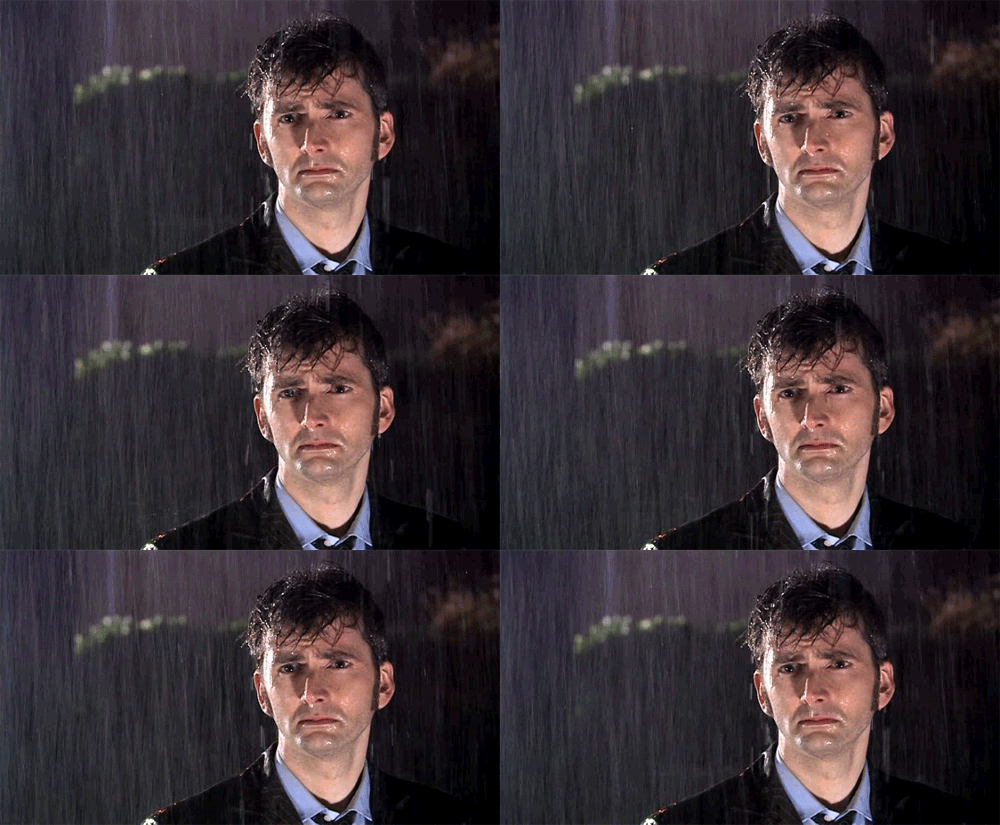
But it turns out it was a good thing I couldn’t find it right away because I soon found myself with a travel buddy named Chris from Germany. And he had lived and taught in China for a few years so he could communicate fairly efficiently which came in handy multiple times throughout the day.
After making our way from the local bus to the train station where the next bus was waiting to take us to the site of the warriors, we were ushered onto a bus by a very emphatic woman. It had one of the two bus numbers we were looking for so we hopped on.
We ended up squished in the back row with an elderly gentleman who sat smack dab in the middle of the rear seat (which could hold 5 people) forcing Chris and I to smoosh in the corner so he could spread his legs out. He had a large cane and I think all of about three teeth. The whole ride all I could think about was hip checking him and shoving him over a bit.
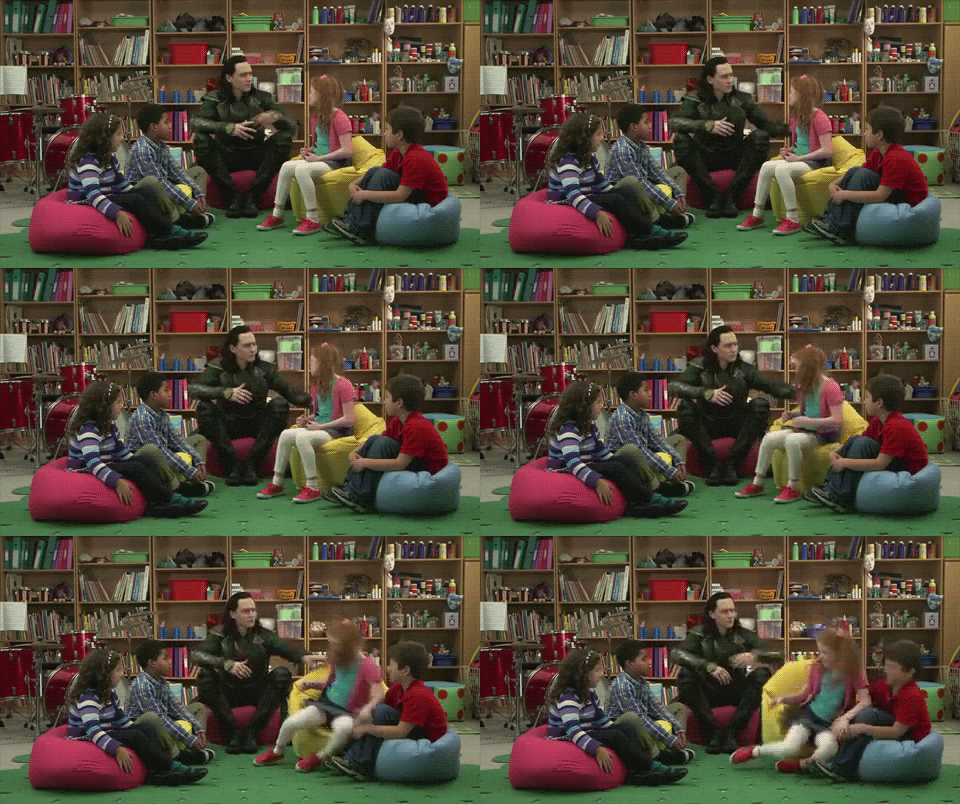
Then the woman who had ushered us on came to collect our money for the trip. She told us it was 9 RMB ($1.50 USD) for the hour long ride. I gave her a 10 RMB bill and she gave me 1 RMB back. Then she went to the next gentleman, a Chinese man, and he have her a 10 RMB bill and she gave him 2 RMB back! Chris immediately asked her what the deal was and, caught in the act, she didn’t really say much except ‘white person price’.
At this point three-toothed Joe Shmoe living it up in leg room luxury starts laughing and laughing as Chris shakes his finger and says something to her in Chinese and she scuttles away. At this point both Chris and I are laughing and Mr. Miyagi next to us laughs even harder.
About 45 minutes into the drive the bus stops - not at the Terracotta Warriors - and those of us left on the bus are told to get off and get onto another bus. Apparently in China if two buses drop off enough passengers they combine forces. Makes more economic sense I suppose?
Finally we find ourselves at the correct location, buy our tickets for 150 RMB ($24.50 USD), go through security (you have to put your bags through an x-ray machine EVERYWHERE in China), and go inside.

The Terracotta Warriors is a collection of sculptures depicting the armies of Qin Shi Huang, the first Emperor of China. It was created by order of the emperor and whose purpose was to protect him in his afterlife.

The figures, created during the late third century BCE, were discovered in 1974 by local farmers. The figures include warriors, chariots, and horses. Estimates from 2007 were that the three pits containing the Terracotta Army held more than 8,000 soldiers, 130 chariots with 520 horses and 150 cavalry horses, the majority of which remained buried in the pits nearby Qin Shi Huang’s mausoleum.

Chris had read somewhere that it’s best to visit the pits backwards. Most books tell you to visit them in numerical order but since Pit 1 is the largest it can make the other two pits a bit of a let down.
We ended up starting with Pit 2 since they weren’t that well labeled but that was fine. The goal was the end with Pit 1 anyway.
Pit 2 has cavalry and infantry units as well as chariots though most of it is broken or destroyed. It was really sad to see all the soldiers and horses lying in pieces on the ground. The statues are extremely old and I’m not sure whether they broke during excavation or just over time. While it’s smaller than Pit 1 it is still a rather large exhibit of Terracotta Warriors and horses.


Pit 3 is smaller than Pit 2 and holds only a few warriors and horses, many of which are broken as well.


The main attraction of the Terracotta Warrior exhibit is most definitely Pit 1. That’s the one that you see in all the pictures.

This place is seriously massive and simply incredible.

Pit 1 is 750 ft long and 203 ft wide and contains the main army of more than 6,000 figures lined up throughout 11 corridors, most of which are more than 9.8 ft wide.


The back portion of the pit is where all the excavation and restoration is still occurring. It’s amazing what these archaeologists have to do - find bits and pieces of the warriors and horses and try to piece them back together. It’s like the world’s hardest puzzle where the pieces don’t line up and one out of every 300 pieces you pick up actually matches. Serious kudos.

Some of them were even wrapped in plastic wrap in order to hold them together as they were reconstructed.

As we made our way back around to the front of the pit a young woman stopped Chris and I and asked if she could practice her English. Chris passed her off to me since English isn’t his first language. She was in training to be a tour guide and seeing as she was going to host three Canadians in a few weeks she was told to try and engage as many English speakers as she could to practice.
At first I thought she just wanted to talk to me and practice her oonversational English but then she started giving me her entire speech on the Terracotta Warriors and Pit 1. It was great because I learned a lot of information about the site from her that normally I would have had to pay 150 RMB for a tour guide to tell me (there isn’t a whole lot of signage in English). Her speech was a long one though so eventually I had to cut her off but other than a few words here and there that I helped her with she did a great job!
After exiting the exhibits Chris and I hailed down a bus heading back to Xi’an and settled in for the lovely bus ride home.
When we returned we took a small 2 hour rest before heading out to the Muslim Quarter and the night market.
Have you ever been lucky enough to get a tour guide for free? Been in a place were someone wanted to practice their English with you?
That sounds like an amazing day! It’s so funny how things just seem to work out while travelling. We were only a little bit jealous to read you’ve found a new travel buddy 🙂 Can’t wait to read about the rest of the events of that night!!
Amazing photos! Thanks for vicariously taking us there with you.
This is definitely on my bucket list! Also love the Lilo and Stitch photo 🙂
Haha thanks! I like adding in reaction pictures every once in a while 🙂
I’ve been there once and this place was even more spectacular and stunning than in the photos I saw on the Internet. This place is full of magic and these warriors are absolutely fantastic!! I miss China a lot these days…. 🙂
I agree seeing it in pictures just doesn’t do it justice! Some people strangely found it boring but I found it fascinating.
Pingback: A day exploring Shaanxi - Mosques, pagodas, and Muslim food - Home Behind - The World Ahead